
Grand Theft Auto and political engagement in an online gaming community
Emma Brewis
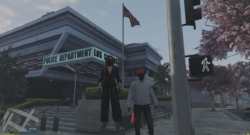 Screenshot by Emma Brewis
by Emma Brewis, PhD Researcher and CDP PGR member
What does political engagement look like in an online gaming community? My PhD research uses ethnographic methods to explore how players bring politics into their online spaces. Rather than looking only to traditional forms of political engagement, my research looks to online spaces, where players have created opportunities for political engagement and democratic participation within their roleplaying communities. This blog adapts a piece originally published in The Conversation and explores some of these examples of political engagement through in-game politics.
The gameplay trailer for Grand Theft Auto VI, one of the most anticipated entertainment releases of the decade, landed at the end of August. Following two trailers which garnered over 500 million views, the preview showcased the latest US city to be parodied by the franchise where players will drive, commit crimes, socialise and play out the narrative developers have in store. Rockstar's Rob Nelson said the game will be careful about what it parodies and will avoid directly addressing Trump and COVID-19 but Rockstar may have less control of GTA politics than we think.
When we think about engaging in politics, we tend to think about voting, contacting politicians or taking part in protests, but people also engage with politics in the communities and spaces where they spend their time. In online roleplaying games, millions use them not just as a space to play but to socialise and make decisions together. This raises questions about what political engagement can look like beyond the institutions we usually associate with it and how these online communities can involve players in politics in way the offline world does not. In Grand Theft Auto V online roleplay, players create their own communities – and they are no strangers to politics.
GTA V has an astonishing legacy, holding the world records for best-selling videogame in 24 hours, most critically acclaimed PlayStation 4 videogame and fastest videogame to gross $1 billion. Its satire of American society and politics has attracted considerable academic attention, while, more than a decade after its release, the House of Lords continues to debate the boundaries of what it should depict. Despite a successful petition which culminated in a ban from Australian stores, even negative reviews of the fifth instalment were tempered by praise.
GTA’s politics are not just limited to what Rockstar writes into the games. The online portion of the game has connected players worldwide to utilise the architecture of Los Santos to play out their own stories, police roleplay, theatre, protests and even elections. In these emergent worlds, players use proximity voice chat to embody characters, take on jobs and create their own rules and institutions. Rather than simply playing through a pre-written storyline, players adopt characters and interact with one another as those characters, collectively creating an ongoing story.
A ballot box in Los Santos
During my ethnographic research, conducted in 2025, I lived as my avatar ‘Alice’ for six months in GTA V roleplaying servers, learning their rules, understanding their customs and becoming part of their community. I participated alongside other players: I worked, attended events, became a reporter and even married a gang leader. Over time, logging in to a four or five hour session in the game felt like returning to a familiar city rather than just playing a game. These were spaces where players lived full and immersive lives, working jobs like sanitation, holding Alcoholics Anonymous meetings and attending weekly church services delivered by an in-game minister.
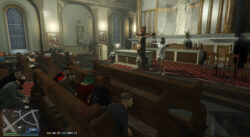
Above: Players attend weekly church service. Screenshot by Emma Brewis
Rockstar’s control over GTA’s politics ends where the players’ creativity begins. Some servers used simple, town hall votes to make decisions about important issues, borrowing a UK Parliament-style division lobby of “ayes” and “noes”. Others held elections to choose their governor and legislative branch, forming a comprehensive political structure complete with government departments. The legislature could introduce and debate new laws, while the judicial system provided a mechanism for resolving disputes.
I was able to take part in one server’s biannual election, culminating in going to city hall to cast my ballot. The election looked surprisingly familiar. At the debates, candidates made opening statements, answered questions from the host and then faced questions from an audience of players. One asked how they would write a bill, a test set by a former member of government to see whether candidates understood the job. Another asked where they stood on the death penalty, a contentious issue under the previous administration. Voting involved a trip to city hall, removing my mask to enter the building and ranking my voting preferences on the ballot paper.

Above: Voting in the election at city hall. Screenshot by Emma Brewis
In interviews, some players described relatively limited engagement with conventional offline politics. One participant told me “no, I don’t vote…I thought about it a couple of times but it’s just, it’s one of those, I don’t know what actually goes on, I don’t know what they’re doing”. Yet within the server they were enthusiastically participating in decision-making and political discussions. Across my research, I repeatedly saw players adding political institutions and processes to spaces in which they did not already exist. They had found ways to decide ‘who gets what, when and how’ in the server – perhaps the very essence of politics – in an effective and engaging way.
It’s Rockstar’s world – but players make the rules
At a time when dissatisfaction with politics remains high, trust in politics and politicians continues to be low and turnout at elections is falling, it is striking that players are taking politics to GTA V online roleplaying servers, beyond Rockstar’s own design. For some, the online space is more engaging; players encounter forms of political participation that feel meaningful to them. The fictional setting does not make the participation itself fictional: players still spend their time debating candidates, negotiating rules, voting and deciding what should happen in the community they inhabit.
GTA VI will undoubtedly be shaped by Rockstar's decisions. They can decide which political subjects to leave out and which to include, but once millions of players enter GTA VI’s online worlds, they will bring their own ideas, communities and forms of organisation with them. GTA V’s online communities show that politics can come from players who create elections, governments, debates and decision-making themselves. So perhaps the question isn't whether GTA VI will be political, it's what players will do with the political possibilities it gives them.
Author
Emma Brewis
PhD Researcher